Why use an embroidery digitizing company for logos?
An embroidered logo can make a brand look established, professional, and memorable. Whether it appears on uniforms, caps, jackets, workwear, bags, or promotional products, embroidery gives a logo a physical quality that printed graphics cannot always match. 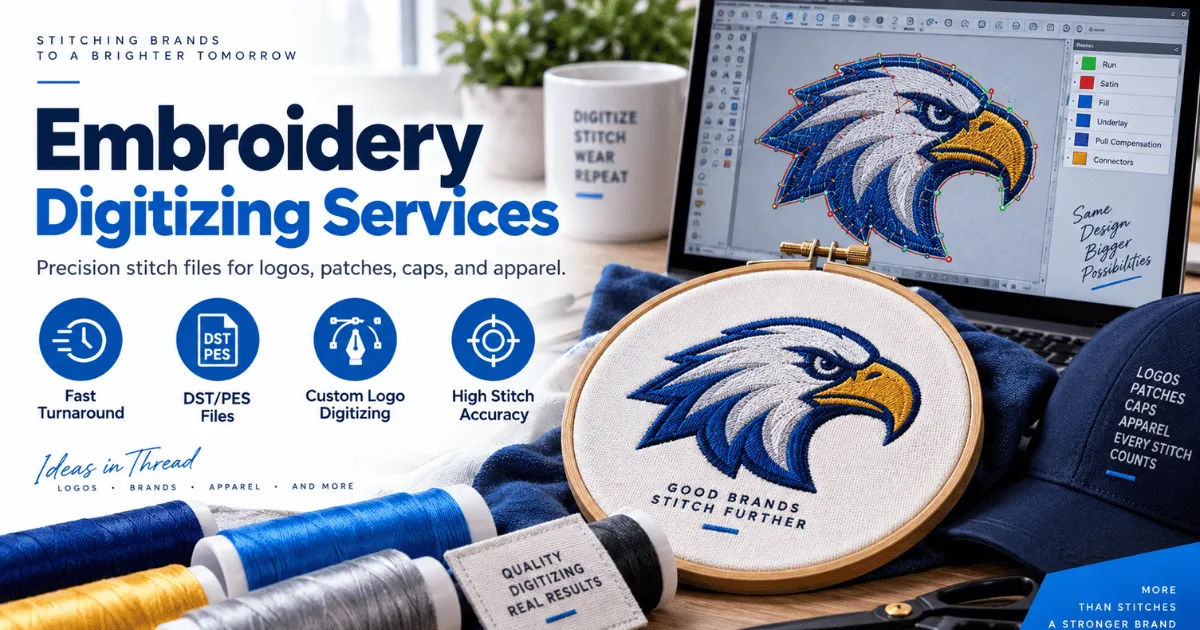 However, turning a digital logo into a clean embroidery design requires more than simply uploading an image to an embroidery machine. This is where an embroidery digitizing company becomes valuable.
A professional embroidery digitizing company converts artwork into a stitch-based embroidery file that tells the machine exactly how to create the design. It considers stitch direction, density, underlay, thread changes, sequencing, fabric type, and design size. These details can have a major effect on how the finished logo looks and performs.
For businesses investing in branded clothing, using professional digitizing services can reduce production problems and help maintain a consistent visual identity. The process combines technical knowledge with design judgment, making it much more than a simple file-conversion task.
What Is Embroidery Digitizing?
Embroidery digitizing is the process of converting artwork into a digital embroidery format that an embroidery machine can understand.
A normal logo may consist of pixels, vectors, lines, shapes, and colors. An embroidery machine does not work directly with those elements. Instead, it follows instructions based on stitches.
The digitizer decides where stitches should begin and end, which direction they should follow, how closely they should be placed, and which parts of the design should be stitched first.
The final file may use formats such as DST, PES, EXP, JEF, or other machine-specific formats. The appropriate format depends on the embroidery machine being used.
This means digitizing is essentially the bridge between graphic design and physical embroidery.
Why Logos Need Professional Digitizing
A logo may look perfect on a computer screen but behave differently when stitched onto fabric.
For example, a very thin line might be clearly visible in digital artwork but disappear when embroidered. Small letters can become difficult to read. Closely packed stitches may cause the fabric to become stiff or distorted.
Professional digitizing addresses these issues before production.
An experienced embroidery digitizing company studies the artwork and determines how it should be reconstructed with stitches. Instead of treating every logo the same way, the digitizer adjusts the design according to its shapes, details, colors, size, and intended application.
This approach can make the difference between a logo that looks polished and one that appears messy or uneven.
Better Stitch Accuracy
One of the biggest reasons to use an embroidery digitizing company is improved stitch accuracy.
Professional digitizers understand how different stitch types behave. Satin stitches, fill stitches, and running stitches each have different purposes.
Satin stitches are commonly used for borders, lettering, and narrow shapes. Fill stitches are useful for larger areas. Running stitches can define fine lines and details.
Choosing the correct stitch type helps preserve the appearance of the original logo.
A professional digitizer also controls stitch angles. When stitches follow the natural shape of a design, the embroidered logo can appear more dimensional and visually balanced.
Improved Logo Readability
Text is one of the most challenging parts of embroidered logos.
Small lettering requires careful planning because thread has physical thickness. If letters are too small or stitches are too dense, the words can become difficult to recognize.
A professional embroidery digitizing company can simplify small details while preserving the overall identity of the logo.
This does not necessarily mean changing the brand design. Instead, it means adapting the artwork to the limitations of embroidery.
For example, a tiny gap between two letters may need to be increased slightly. A narrow line may need to become wider. Small decorative details may need to be removed when they cannot be reproduced clearly.
These adjustments help ensure that the embroidered logo remains readable.
Consistent Brand Appearance
Brand consistency is important for companies that use logos across multiple products.
A business may place its logo on shirts, jackets, hats, uniforms, backpacks, and promotional items. These products can use different fabrics and different embroidery sizes.
If each design is digitized differently, the logo may appear inconsistent from one product to another.
Working with an embroidery digitizing company can create standardized embroidery files for different applications.
For example, a business might have one version optimized for large jacket embroidery and another optimized for small cap embroidery. Both can maintain the same overall branding while being technically adapted to their specific uses.
Better Results on Different Fabrics
Fabric has a major influence on embroidery quality.
Cotton, denim, fleece, polyester, canvas, performance materials, and other textiles can behave differently during stitching. Some fabrics are stable, while others stretch or move easily.
Professional digitizers consider the characteristics of the material when preparing a design.
Underlay stitches can provide stability beneath the visible stitches. Density can be adjusted to prevent excessive thread buildup. Stitch direction can also be selected to improve coverage and appearance.
A design intended for a stable jacket may therefore need different settings from a design intended for lightweight sportswear.
This fabric-specific approach is one of the major advantages of professional digitizing.
Reduced Production Problems
Poorly prepared embroidery files can create several production issues.
Thread breaks, puckering, excessive density, gaps, uneven coverage, and registration problems can all occur when a design has not been properly digitized.
These problems waste time and materials.
A professional embroidery digitizing company aims to identify potential issues during the preparation stage. Although no digitized design can guarantee perfect production under every condition, professional preparation can significantly reduce avoidable problems.
The result is a smoother embroidery process and fewer surprises when the design reaches production.
Professional Handling of Complex Logos
Some logos contain gradients, intricate shapes, overlapping elements, shadows, or multiple colors.
Not every visual detail can be reproduced exactly through embroidery.
A skilled digitizer knows how to interpret complex artwork and determine which elements should be represented through stitches.
Instead of trying to copy every pixel or visual effect, the digitizer focuses on preserving the important characteristics of the brand.
This can involve using stitch direction, layering, thread colors, and carefully selected stitch types to create a convincing embroidered version.
The goal is not simply to convert artwork. The goal is to recreate its visual identity in a physical medium.
Proper Stitch Density
Stitch density refers to how closely stitches are placed within an embroidered area.
Too little density can leave gaps and expose the fabric underneath. Too much density can create stiffness, excessive thread buildup, puckering, or unnecessary production time.
Finding the right balance requires experience.
An embroidery digitizing company can adjust density according to the design and fabric instead of relying on one standard setting for every project.
This is particularly important for large filled areas and detailed logos where poor density control can noticeably affect quality.
Correct Stitch Sequencing
The order in which different elements are embroidered matters.
If a design is stitched in an inefficient sequence, some elements may shift or become covered by later stitches. Poor sequencing can also increase unnecessary thread trims and color changes.
Professional digitizers organize the embroidery sequence logically.
Large background areas may be stitched before smaller details. Borders can be placed at appropriate stages. Text and fine elements can be positioned so they remain clear.
Good sequencing contributes to both appearance and production efficiency.
Specialized Support for Cap Logos
Caps present unique embroidery challenges because of their curved surfaces.
A design that works well on a flat shirt may not produce the same result on a structured cap. Curvature, center seams, available embroidery areas, and design width all need to be considered.
A professional embroidery digitizing company can prepare files specifically for cap embroidery.
The digitizer may adjust stitch directions, sequencing, density, and design proportions to accommodate the shape of the cap.
This is especially important for businesses using embroidered caps as part of uniforms, promotional merchandise, or retail collections.
Better Support for 3D Puff Embroidery
Three-dimensional puff embroidery requires specialized preparation.
Foam is placed beneath the stitches to create raised lettering or shapes. The digitized design must account for the physical characteristics of the foam and the way stitches will compress it.
Not every logo is suitable for 3D puff.
Very fine details and small lettering may not work well. Larger, bold shapes generally provide better results.
An experienced embroidery digitizing company can determine which parts of a logo are appropriate for puff embroidery and modify the design accordingly.
This can help businesses create bold logos for caps and other products where a raised effect is desirable.
Saving Time for Businesses
Creating embroidery files internally can require specialized software, training, and experience.
For a business that only occasionally needs embroidered logos, learning professional digitizing techniques may not be practical.
Outsourcing the task allows the business to focus on branding, marketing, production, and sales.
The digitizing provider handles the technical preparation while the business receives a machine-ready file.
This can be particularly useful for companies that frequently introduce new logos, product lines, employee uniforms, or promotional designs.
Cost Efficiency Over Time
Professional digitizing is an additional service cost, but it can contribute to overall efficiency.
A poorly digitized file may lead to wasted garments, repeated production runs, excessive thread usage, and machine downtime.
When a design is properly prepared, production can become more predictable.
Businesses ordering larger quantities may benefit even more because small improvements in production quality can have a significant impact across hundreds or thousands of embroidered items.
The value therefore should not be judged only by the price of the digitizing service. It should also be considered in relation to production quality, consistency, and waste reduction.
Access to Multiple File Formats
Different embroidery machines use different file formats.
A professional embroidery digitizing company can often provide the format required for a particular machine.
This is useful for businesses working with multiple embroidery vendors or changing production partners.
Instead of redesigning a logo from scratch, the same digitized artwork can potentially be prepared in the required machine format.
Businesses should confirm the exact format they need before placing an order because compatibility requirements vary between machines and software systems.
Professional Quality Control
Quality control is another important reason to work with professionals.
A good digitizing workflow may involve reviewing the design, checking stitch placement, examining densities, evaluating small details, and making adjustments before the file is delivered.
Some providers also offer a sew-out or test sample.
A sew-out can reveal problems that are difficult to notice on a computer screen. It can show whether lettering is readable, whether colors work well together, and whether the design behaves properly on the intended material.
Testing becomes especially valuable for important corporate logos and large production orders.
Better Results at Different Sizes
Logos often need to appear at different sizes.
A large back design may require different digitizing decisions than a small chest logo.
Simply enlarging or shrinking one embroidery file does not always produce the best result. Stitch counts, density, detail, and lettering need to be considered.
A professional embroidery digitizing company can create size-appropriate versions when necessary.
This approach helps preserve clarity across different applications instead of assuming that one file will work perfectly at every dimension.
Protecting the Professional Image of a Brand
A company's logo is one of its most recognizable visual assets.
When the logo appears on uniforms or merchandise, customers and employees may associate the embroidery quality with the business itself.
An uneven or poorly stitched logo can make an otherwise professional garment look inexpensive.
High-quality digitizing helps protect the visual presentation of the brand.
This is particularly important for hospitality businesses, corporate uniforms, sports organizations, retail brands, schools, clubs, and promotional campaigns.
What to Look for in a Digitizing Company
Choosing the right provider is important because not all digitizing services offer the same level of expertise.
Look for experience with the type of embroidery you need.
If you primarily embroider hats, choose a provider familiar with cap designs. If your products include jackets and performance fabrics, ask about experience with those materials.
It is also useful to examine examples of previous work.
Pay attention to lettering, curves, borders, small details, stitch consistency, and overall cleanliness.
Communication is another important factor. A good provider should be willing to understand the intended embroidery size, fabric, machine format, and production requirements.
Questions to Ask Before Ordering
Before sending a logo for digitizing, businesses can ask several practical questions.
Do they provide the required file format?
Can they work with both vector and raster artwork?
Do they offer revisions?
Can they prepare designs for caps or 3D puff?
Do they consider the intended fabric?
Can they provide a test sew-out when necessary?
What is their typical turnaround time?
These questions can help clarify whether the provider is equipped for the project.
When Professional Digitizing Is Especially Important
Professional digitizing is particularly valuable when the logo will be used for a large production order.
It is also worthwhile when the logo contains small lettering, complicated shapes, multiple colors, or detailed borders.
Businesses producing premium garments should also prioritize professional preparation because the embroidery itself is part of the product's perceived quality.
For occasional personal projects, simple designs may require less specialized work. However, commercial branding usually benefits from a more controlled and professional process.
PSA Digitizing specializes in turning creative artwork, business logos, and other designs into embroidery-ready files. As a professional embroidery digitizing company, it provides formats such as DST, PES, JEF, and more to support a variety of embroidery machines. The team is located in Clarkston, Georgia, USA, and combines skilled digitizing techniques with modern software to create files that are clean, detailed, and suitable for stitching.
Customers can rely on PSA Digitizing for a range of embroidery-related projects, from simple logo conversion to custom patch designs. With a 4.5+ star rating on Trustpilot, the company has built a positive reputation for responsive service, reliable turnaround, and quality-focused results. The goal is to make the entire digitizing process easy and convenient. Visit psadigitizing.com if you are ready to convert your artwork into an embroidery file.
Conclusion
Using an embroidery digitizing company for logos is about much more than converting an image into an embroidery file. It is about adapting a brand's visual identity to the physical limitations and possibilities of thread.
Professional digitizing can improve stitch accuracy, lettering readability, fabric compatibility, stitch density, sequencing, and overall production consistency. It can also help businesses prepare specialized designs for caps, jackets, uniforms, 3D puff embroidery, and other applications.
A logo that looks excellent on a computer does not automatically translate into excellent embroidery. Thread has thickness, fabric moves, machines have limitations, and different surfaces require different approaches. Professional digitizing accounts for these realities before the design reaches production.
For businesses, this can mean fewer production problems, less material waste, better-looking merchandise, and stronger brand consistency. It can also save valuable time because the technical preparation is handled by people who understand embroidery rather than by someone learning the process while working on a commercial order.
The best results come from treating digitizing as an important part of the branding process rather than as a simple technical step. When the artwork, fabric, size, machine, and embroidery technique are considered together, the final logo is more likely to look clean, balanced, and professional.
Ultimately, an embroidery digitizing company gives businesses access to specialized knowledge that can turn ordinary digital artwork into a practical, attractive embroidery design. For organizations that care about how their logos appear on clothing and merchandise, professional digitizing is a worthwhile investment in both quality and brand presentation.